

Initial findings & research objective
Subterranea refers to an ecosystem that lies beneath the Earth’s surface and has not yet been explored. It is believed that this system is located in deep regions of the Earth’s crust or in the upper mantle.
The first clues come from Edwin Terrus’s records. In them, he describes unusual observations that suggest the existence of an unknown underground world.
- unusual rock formations
- indications of large underground cavities
- unexplained temperature and air currents
- possible traces of unknown life forms
The following questions are central to this discussion:
- Which of the hypothesised life forms could potentially exist?
- To what extent can the described habitats actually be verified?
- What are the actual conditions in these areas?
Flora & Fauna
Flora & Fauna
Plant life
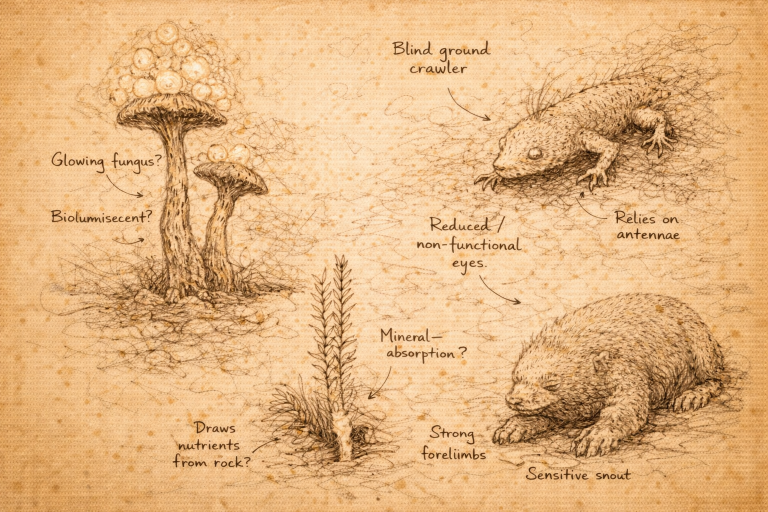
Organisms with unusual properties are particularly noticeable:
- possibly bioluminescent fungi (produce their own light)
- plants that utilize natural heat from the Earth’s interior
- organisms that absorb minerals directly from the rock
These adaptations enable survival without sunlight.
Wildlife
Animal organisms also exhibit special characteristics:
- reduced or barely functioning eyes
- orientation via alternative sense organs
- adaptation to darkness and confined spaces
Humanoid life forms
Humanoid life forms
Possible origin
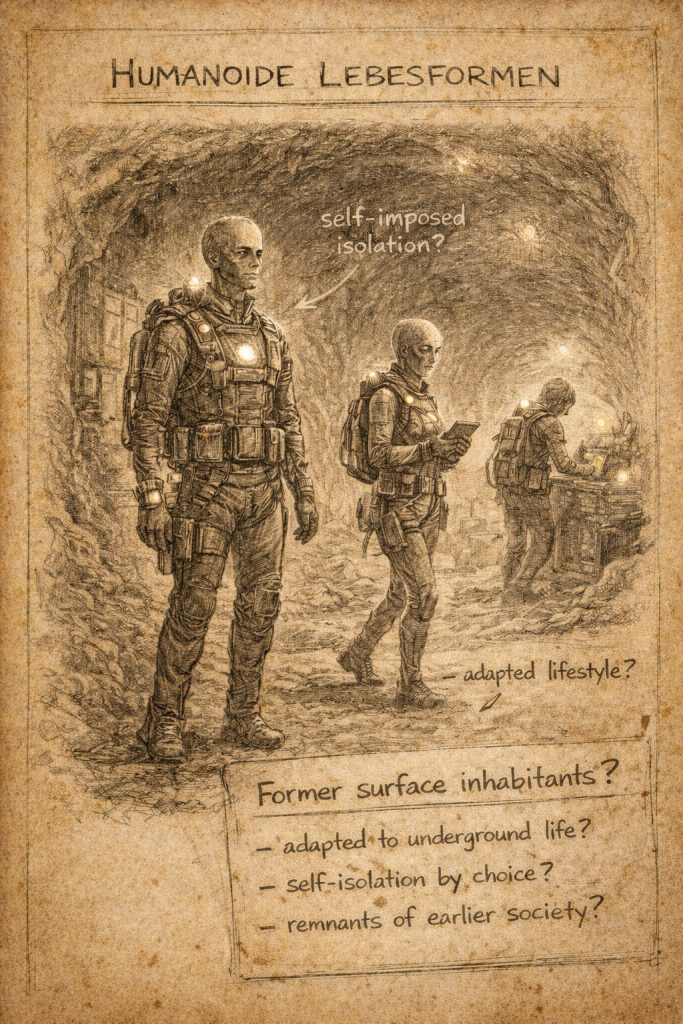
It seems likely that these could be groups who live in Hollow Earth for different reasons.
Possible reasons:
- searching for alternative lifestyles
- exclusion from previous social structures
Appearance
The humanoid life forms predominantly exhibit human body shapes with slight modifications:
- adapted perceptual abilities
- less dependence on light
- functional, minimalist equipment
Technology
They seem to have an organized way of life:
- use of lighting or orientation aids
- multifunctional tools
- adapted equipment for life underground
Open questions
So it remains unclear:
- whether the beings are Homo sapiens
- how long these groups have been living in Hollow Earth
- whether they consciously chose this lifestyle
This cannot be definitively clarified based on Terrus’ records and notes.
Habitat
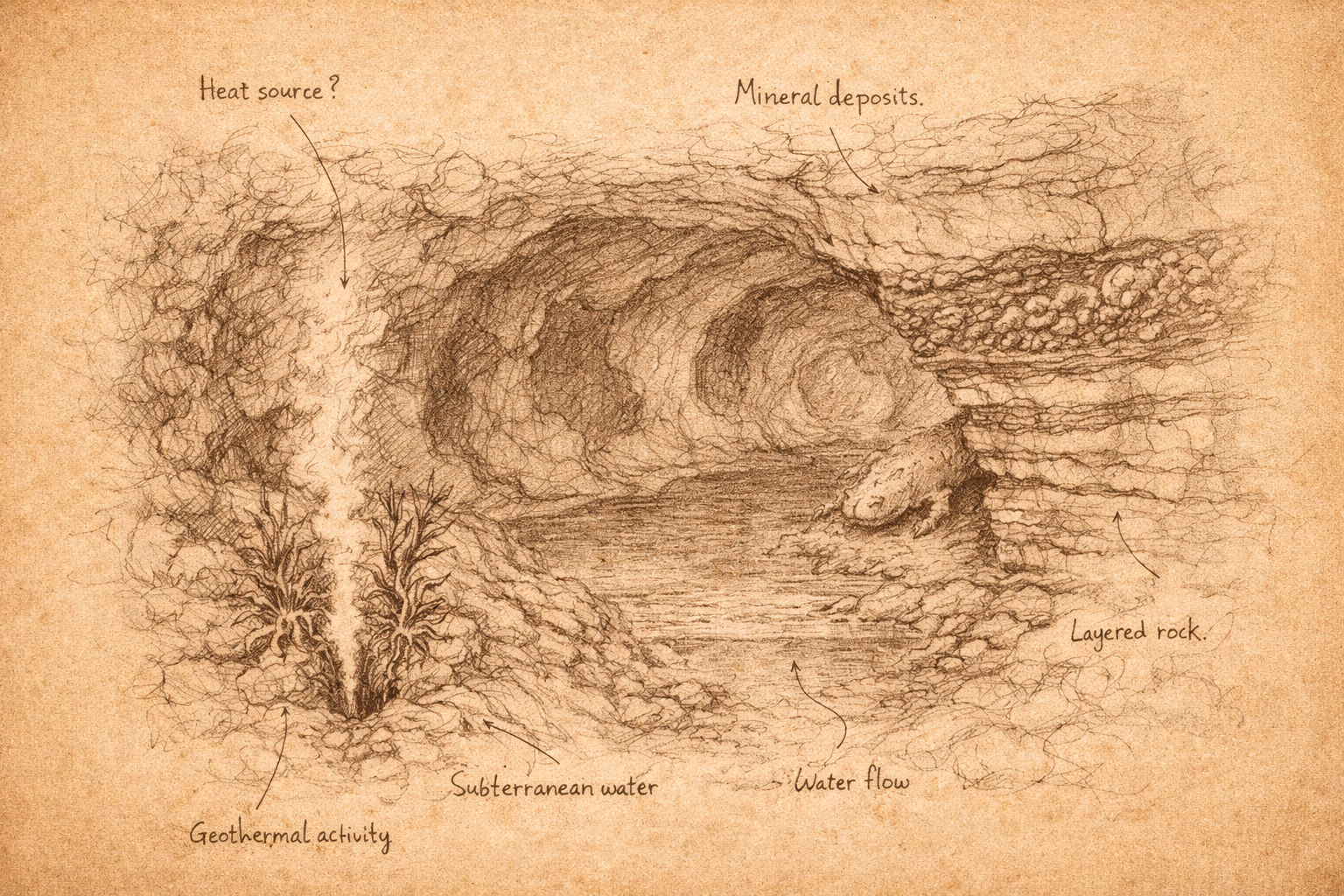
Hollow Earth consists of a vast, branching system of underground spaces.
Cave structures
The structures described by Terrus go beyond ordinary caves:
- large, interconnected cavities
- multiple levels with natural connections
- stable rooms with solid walls and ceilings
- a network of corridors and chambers
These structures form the basis for independent habitats.
Water sources
- small underground lakes
- narrow waterways
- interconnected water systems
These likely play a central role in the ecosystem.
Heat & energy
Elevated temperatures are occurring in some areas:
- natural heat from the Earth’s interior (geothermal heat)
- locally varying temperature zones
This heat likely serves as an energy source.
Rock & life forms
Some organisms appear to be directly connected to the rock:
- mineral intake
- use of chemical substances as an energy source
- growth on or in rock
The rock thus functions not only as an environment, but as an active component of the life system.
Role in the ecosystem
This combination of:
- cave structures
- water
- heat
- mineral resources
This could form the basis for stable habitats in Hollow Earth, thus enabling the existence of diverse, sometimes complex, life forms.
Habitat
Habitat
Hollow Earth consists of a vast, branching system of underground spaces.
Cave structures
The structures described by Terrus go beyond ordinary caves:
- large, interconnected cavities
- multiple levels with natural connections
- stable rooms with solid walls and ceilings
- a network of corridors and chambers
These structures form the basis for independent habitats.
Water sources
- small underground lakes
- narrow waterways
- interconnected water systems
These likely play a central role in the ecosystem.
Heat and energy
Elevated temperatures are occurring in some areas:
- natural heat from the Earth’s interior (geothermal heat)
- locally varying temperature zones
This heat likely serves as an energy source.
Rock and life forms
Some organisms appear to be directly connected to the rock:
- mineral intake
- use of chemical substances as an energy source
- growth on or in rock
The rock thus functions not only as an environment, but as an active component of the life system.
Role in the ecosystem
This combination of:
- cave structures
- water
- heat
- mineral resources
This could form the basis for stable habitats in Hollow Earth, thus enabling the existence of diverse, sometimes complex, life forms.

Social structure & politics
Society
His notes reveal the following characteristics of the social order of Subterranea:
Politics
The political system is clearly characterized by the principle of equality and exhibits the following features:
As can be seen, there are major cultural and political differences between our world and Hollow Earth. Therefore, it is a challenge to faithfully portray the underground society due to our worldview.